

SIBERIA
Fifteen contaminated acres at the Watervliet Arsenal

Author’s Note
This is a longform Restoration Obscura feature.
If you are receiving this article in your inbox, your email client may clip or truncate the content due to its length. You can always read the complete version directly on Restoration Obscura, where the full text is presented without interruption.
Restoration Obscura articles are written works intended to be read as text. Substack may automatically generate an AI-based audio narration of this article within the Substack app. Pronunciations of certain place names, personal names, and historical references in these auto-generated narrations may be inaccurate. The written version should be considered the authoritative source.
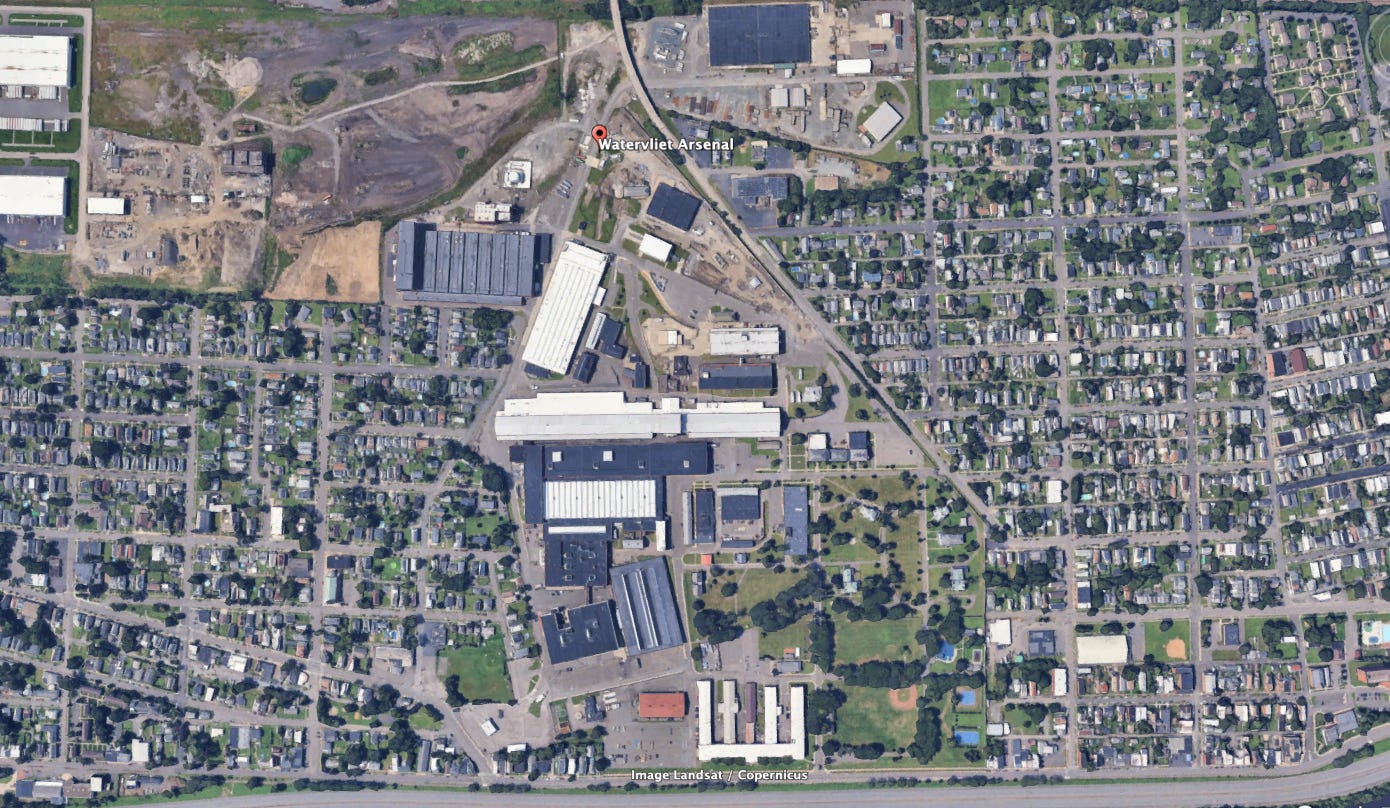
On the western edge of the Watervliet Arsenal, past the forge shops and the machine halls that have produced American artillery since 1813, sits a fifteen-acre plot that the federal government calls Siberia. The name appears in Environmental Protection Agency consent orders, in New York State Department of Environmental Conservation cleanup plans, in Army environmental filings that catalog what lies in its soil: chlorinated solvents, petroleum hydrocarbons, heavy metals, three underground storage tanks that remained in place as of the Army's 2021 environmental documentation. No official order naming the site has been located. The name started as a complaint among freezing workers in an unheated wartime depot. Eighty years later it names a problem the government expects to manage past the working life of everyone now inside the fence.
Act One: The Depot
The Watervliet Arsenal was already the oldest continuously operating arsenal in the United States when the Second World War arrived at its gates. Founded in the summer of 1813 to arm the northern frontier during the War of 1812, it had grown from a twelve-acre riverside parcel at the village of Gibbonsville into the Army’s cannon factory. The Erie Canal was cut directly through the grounds in the 1820s, and by the following decade the arsenal was drawing hydropower from the canal to run its shops. When the Army needed its first sixteen-inch guns, Watervliet built them. The Big Gun Shop, Building 110, still stands and continues to manufacture large-caliber cannon.
The interwar years hollowed the place out. After employing more than five thousand craftsmen during the First World War, the arsenal had shrunk to a few hundred skilled machinists by the late 1930s. The turnaround began in November 1938, when Colonel Richard Somers took command and started preparing for a war he believed was coming. A Works Progress Administration project reconditioned the old factory buildings. An apprentice school opened in August 1939 to train machinists in a three-year course. The payroll climbed past one thousand by the summer of 1939, past seventeen hundred a year later, past three thousand by December 1941. President Roosevelt himself toured the Big Gun Shop in October 1940, watching cannon forgings under the escort of Brigadier General Alexander Gillespie, a rare general officer at a post the Army usually left to colonels.
The war remade the workforce as much as the workload. Women Ordnance Workers, the WOWs, moved into positions across the arsenal after three-week training courses, running drill presses, milling machines, and hydraulic cutters. Supervisors found them suited to nearly all of the manufacturing and repair work. A shop foreman said of Jean Wiorek, a twenty-two-year-old machinist from Albany, that she could “turn out a reamer as perfect as any toolmaker ever could.” An eighteen-year-old typist from Troy named Maureen Stapleton passed through the arsenal’s offices in 1943 on her way to a Hollywood career and an Academy Award.
Some of those women worked in a building the arsenal’s official histories treat as an afterthought: the Field Service Depot, where repair parts were packaged and shipped to Allied armies around the world, three shifts a day, six days a week. The work there was as essential as anything happening in the forge shops and considerably less glamorous: a cannon without spare breech parts is a sculpture, and the armies fighting across North Africa and Europe consumed repair parts at rates the prewar Army had never imagined. The depot was the arsenal’s connection to every gun it had ever shipped. It was also unheated. In a Hudson Valley winter, in a war economy that rationed coal and lumber and everything else, the workers packing crates in that building reached for the only name that fit. They came to call it Siberia.
Keep reading with a 7-day free trial
Subscribe to Restoration Obscura to keep reading this post and get 7 days of free access to the full post archives.