Project Nike
Nuclear missiles in the New York suburbs, 1955–1974


Author’s Note: This piece exceeds typical email length and may be clipped by your mail client. You can always read the full version at restorationobscura.substack.com.
An AI-generated audio narration is available through the Substack app as an automatic accessibility feature. It may struggle with proper names and place names. The written text is the authoritative version of record, this article was meant to be read.
A new episode of the Restoration Obscura Field Guide Dispatch is on its way to all major streaming platforms.
Thank you for being a subscriber.
The infrastructure built to protect New York City has never been visible to the people living inside it. That is, in a sense, the point. The systems designed to detect threats, absorb damage, and buy time for a response have always been embedded in the landscape of daily life, on hilltops, in server rooms, behind fences marked with signs that do not explain what the signs are protecting. The city goes about its business. The apparatus watches.
Today that apparatus is largely digital. The NYPD’s Domain Awareness System connects more than 18,000 closed-circuit cameras across the five boroughs, feeding continuous video into a command center in Lower Manhattan. License plate readers generate roughly three million records per day. Radiation sensors scan passing vehicles for isotopic signatures. Most New Yorkers pass through it every day without thinking about it.
One hundred and fifty miles up the Hudson Valley, on a hill above Stillwater in Saratoga County, the concrete footprint of a different kind of awareness system is slowly disappearing into the tree line. The Saratoga Springs Air Force Station, operated by the 656th Radar Squadron, was part of SAGE, the Semi-Automatic Ground Environment, a continent-spanning network of radar stations, computers, and human operators built in the 1950s to detect Soviet bombers before they reached American cities. The Stillwater station opened in February 1951. Its radar towers had a clear line of sight across the upper Hudson corridor, one of the approach paths a bomber crossing the pole might follow toward New York. The data those towers collected fed into direction centers that coordinated the entire northeastern air defense picture in real time. The station closed in 1977. The FAA used the site briefly afterward to track transatlantic commercial flights. Then it was abandoned. The towers are gone. The buildings remain, along with an underground bunker and a historical marker erected by the veterans of the 656th.
The radar station at Stillwater and the missile batteries ringing New York City were part of the same architecture of protection, built on the same logic: that the threat would come from outside, that it would be detectable if you put enough eyes in the right places, and that the seconds or minutes of warning those eyes could provide might make the difference. The Nike batteries were the response mechanism. The SAGE stations were the nervous system that fed them. Between 1955 and 1974, nineteen Nike missile batteries occupied hilltops and barrier beaches in a rough ring around the city, each one staffed around the clock, each one connected to a detection network that stretched from the Hudson Valley to the Canadian border.
The hilltop above Orangeburg, New York, offers a long view across the Tappan Zee. In the 1950s, the Army chose this ridge for a reason. From the summit of Mt. Nebo, on the Clausland Mountain ridgeline, the radar arrays had a clear line of sight across the Hudson and north toward the Catskills, the most likely approach corridor for Soviet bombers crossing the pole. The concrete platforms that supported those arrays are still there. The radar towers are gone. What remains are circular foundations, the rusted stub of a perimeter fence, a small guardhouse covered in graffiti. On the trail maps, the site is listed as Nike Missile Overlook Park. Most people who hike through it do not know what they are looking at.
Jet Age Advancements
The project that produced those radar towers began in 1944, before the war had ended. The Army Air Forces had already encountered German jet aircraft in European skies and understood what was coming: a new generation of bombers that could fly faster and higher than any anti-aircraft artillery could track. The manual aiming solutions used by gun crews assumed a relatively slow, predictable target. Against an aircraft moving at high altitude near the speed of sound, they were effectively useless.
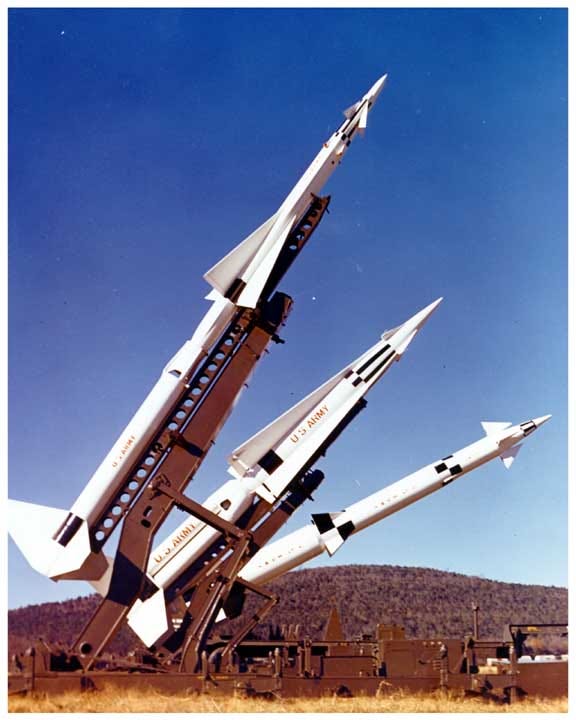
Bell Laboratories, under contract to the Army, spent nearly a decade developing a solution. The result was named after Nike, the Greek goddess of victory. The Nike Ajax, operational by 1953, was a two-stage, radar-guided surface-to-air missile capable of reaching altitudes above 70,000 feet at speeds exceeding Mach 2. Guidance came entirely from the ground: a computer that tracked both the target aircraft and the missile simultaneously, calculated an intercept point in real time, and transmitted steering corrections until the moment of detonation. The missile itself carried no seeker. Three separate radar systems, acquisition, target tracking, and missile tracking, had to operate in precise coordination for a single shot to succeed.
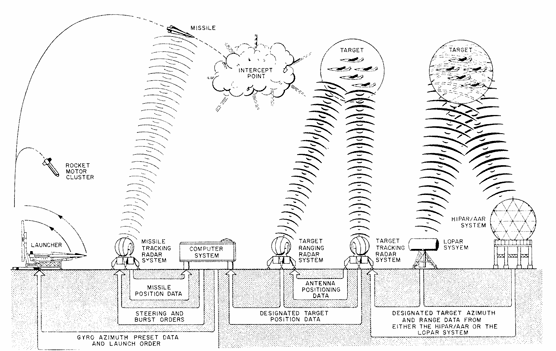
Illustration of how the Nike syA U.S. Army diagram illustrating the Nike fire control sequence. Three separate radar systems worked in coordination: acquisition radar identified the incoming aircraft, target tracking radar locked onto it continuously, and missile tracking radar followed the interceptor from launch through detonation. The ground-based computer calculated the intercept point in real time. The missile itself carried no seeker. U.S. Army.stem functioned. The target is acquired by Acquisition Radar, then tracked by Target Tracking Radar. A missile is launched, and its path is tracked by Missile Tracking Radar. The enemy is then intercepted in the sky before reaching the city. U.S. Army
Between 1955 and 1961, the Army built nineteen Nike batteries around New York City. They were positioned in a rough ring, sited far enough from the urban core that spent missile hardware would not fall on densely populated streets, but close enough to intercept incoming aircraft before they reached their targets. The sites occupied hilltops in Rockland and Westchester counties, barrier beaches in Queens, wooded tracts on Long Island, and hillsides across northern New Jersey. Approximately 109 officers and men were required to operate a single battery around the clock.

The Sites
Each battery had three distinct components. The Integrated Fire Control area, typically on elevated ground, housed the radar systems and the fire control building where operators tracked targets and commanded launches. The launcher area, sometimes separated from the IFC by a mile or more of terrain, held the underground missile magazines: reinforced concrete structures where missiles were stored horizontally, raised to the surface on elevators when needed, and moved on rails to the launch pads above. The administrative area, barracks, mess hall, motor pool, was usually co-located with the IFC.
The site at Orangeburg was designated NY-03/04, a double battery capable of engaging two targets simultaneously. It held sixty Nike Ajax missiles in its original configuration. By 1960, the Ajax had been superseded by the Nike Hercules, larger, faster, with a range of nearly ninety miles, and the Orangeburg magazines were modified to accept the new system. NY-03/04 was one of only four sites in the New York area upgraded to the Hercules. The new missiles carried W-31 nuclear warheads with selectable yields up to 20 kilotons. At its Hercules peak, the site held eighteen missiles, most of them nuclear.
A 20-kiloton warhead detonated at altitude does not need to hit an aircraft. The blast radius and the electromagnetic pulse from a single Hercules could destroy multiple planes in formation. The tactical logic had shifted from interception to obliteration.
Life on the Ridgeline
The soldiers stationed at sites like Orangeburg lived under a permanent alert structure. One launcher was kept at fifteen-minute readiness at all times; others at thirty minutes and two hours. Unannounced drills tested the crew’s ability to transition from sleep to launch sequence within the required window. The drills had a name: Blazing Skies. Children in the neighborhoods below the ridge grew up hearing the phrase without knowing what it meant.
The Army worked actively to normalize the installations. Missiles were displayed at county fairs, church bazaars, and Boy Scout Camporees. The official line, repeated at public meetings and in press releases, was that a Nike site was no more dangerous to its neighbors than a local gas station. For several years, most communities accepted this framing. Then, on May 22, 1958, the gas station blew up.
Leonardo, New Jersey
Site NY-53, in Middletown Township, was one of the New Jersey batteries defending the southern arc of the New York ring. The morning of May 22, 1958, began as a routine maintenance evolution. Soldiers and civilian ordnance technicians were installing improved safety and arming mechanisms on a group of Nike Ajax missiles that had been brought to the surface from the underground magazines. The procedure required removing two of the three warheads from each missile to allow access to the arming components. It was delicate work, being conducted in the open air, on the launch pads, with multiple missiles in various stages of disassembly.
While modification work was underway on one missile, something failed. The Army’s investigating board, working through the physical evidence left by the explosion, concluded that a warhead sitting on the ground detonated. The chain reaction was nearly instantaneous. Seven other missiles on adjacent pads detonated in rapid sequence. Ten men died, six soldiers and four civilians. The explosion shattered windows across a wide radius. Missile fragments landed in residential backyards up to three miles from the site. A twelve-foot section of missile casing was found in a private yard. Time magazine’s response to the Army’s long-standing public relations position was exact: “Last week the gas station blew up.”
The scale of what the Army found in the aftermath was more troubling than the explosion itself. Operation Fix-it, the crash inspection program that followed, examined nearly 6,000 Nike Ajax missiles across the entire defense network. Of those inspected, 605 were found to have improperly installed arming components. Another 309 contained ruptured or damaged relay caps. The problem was not isolated to Leonardo. It was systemic, distributed across dozens of batteries, present in weapons that had been sitting in magazines beneath suburban neighborhoods for years. The Army had been telling those neighborhoods that the missiles were no more dangerous than a local gas station. The inspection results revealed that the Army had been maintaining that fiction without adequate basis.
The Leonardo site was never converted to Hercules. The Army’s ability to sustain the gas station fiction in that community had ended on the launch pads, and no subsequent press release could restore it. The broader New York Defense Area continued operating, and the official framing of Nike as a benign neighbor persisted in communications directed at other communities along the ring, but the terms were now understood by anyone paying attention to be precisely that: a framing. A granite memorial to the ten men killed at Leonardo stands today at Fort Hancock, Sandy Hook, inside the Gateway National Recreation Area. The site of the explosion is a housing development.
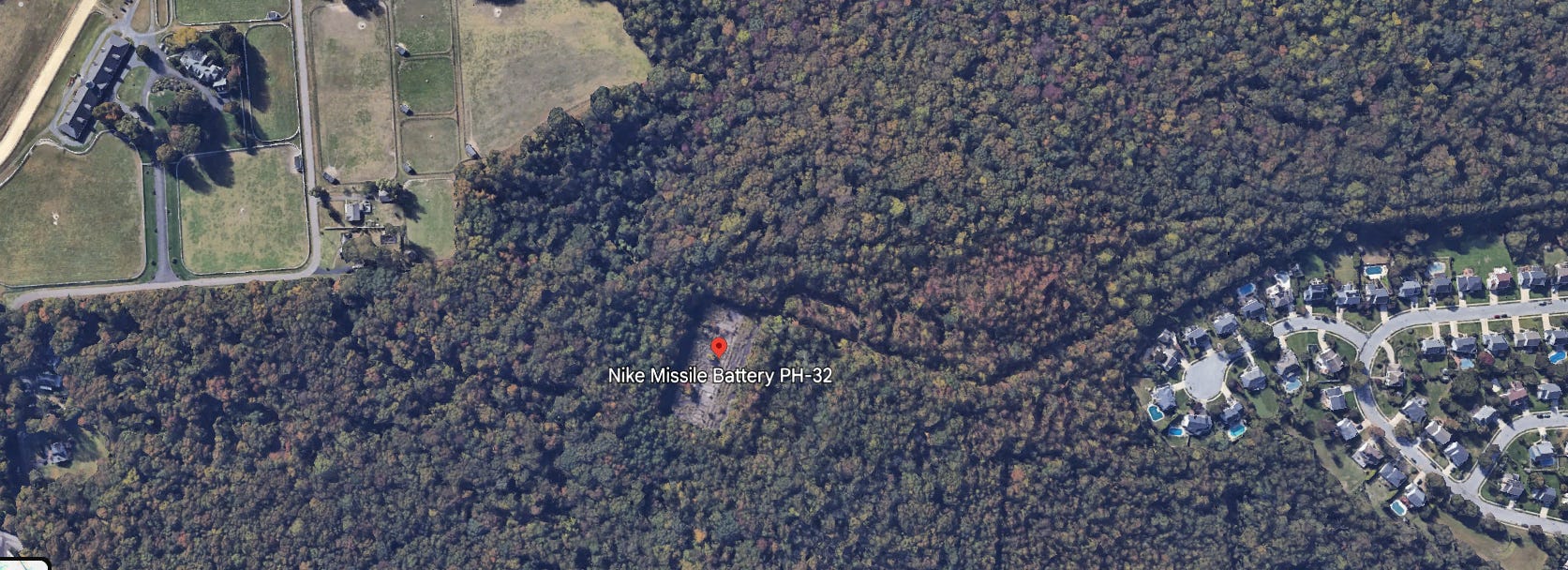
[Above] 39°52′15.91″N 74°52′54.20″W
Nike Missile Site PH-32
Evesham Township (Marlton), Burlington County, New Jersey
Part of the Cold War Philadelphia Defense Area, PH-32 was established in 1955 as one of the Nike Ajax, later Nike Hercules, launch batteries positioned to shield the Delaware Valley from potential Soviet bomber approach routes.
Today the wooded tract in Marlton reveals faint geometric traces from above, concrete launch pads, access roads, and the disciplined grid of a mid-century air defense system, now quiet beneath suburban growth.
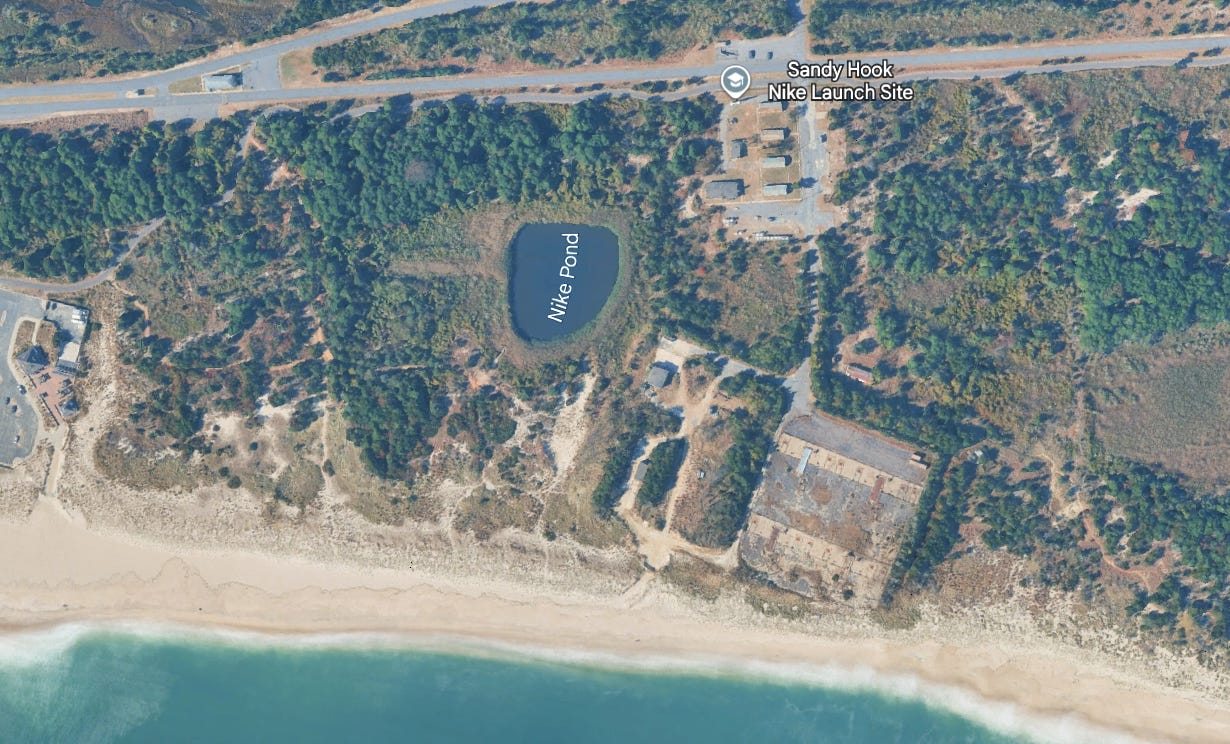
[Below] Sandy Hook Nike Launch Site
40°26′02.54″N 73°59′05.39″W
Sandy Hook, New Jersey
A Cold War Nike missile launch area positioned on the Sandy Hook peninsula to help protect the approaches to New York Harbor. From above, the site’s disciplined geometry still reads through the landscape, faint outlines of pads, service roads, and cleared corridors, an air-defense footprint now absorbed into coastal forest and dunes.
Images: Google Earth
The National Guard and Nuclear Authority
By the early 1960s, as the Army needed active-duty personnel for overseas commitments, operational control of many Nike batteries transferred to the Army National Guard. This included sites in New York and New Jersey. The transfer created an unusual situation with no precedent in American military history: state-level National Guard units were given operational responsibility for live nuclear weapons.
The protocol that governed this arrangement was elaborate. Guard personnel manned the sites continuously and maintained the warheads. But the authority to arm and launch a nuclear missile could only come from the Commander in Chief of Continental Air Defense Command, transmitted through authenticated codes. The Guardsmen were, in effect, full-time custodians of weapons they could not independently use. The arrangement held through the end of the program. No Nike missile, from any site, was ever fired in a live engagement.
The End of the Ring
The threat the Nike system was built to counter began to change before the concrete had finished curing. By the early 1960s, the Soviet Union had deployed intercontinental ballistic missiles that descended from the upper atmosphere at speeds the Nike Hercules could not match. A warhead on a ballistic trajectory is not an aircraft. The Nike system had no answer for it.
The Army developed successor programs, Nike Zeus, Sentinel, Safeguard, aimed at ballistic missile defense. These encountered technical problems that were never fully resolved, including the inability to reliably distinguish incoming warheads from decoys. The broader policy environment was shifting as well. Mutual Assured Destruction had become the doctrinal framework, and the Strategic Arms Limitation Treaty of 1972 restricted the number of ABM sites each superpower could maintain. Under SALT I, the localized defense of cities like New York was incompatible with the agreed structure. By 1974, almost all Nike sites in the continental United States had been deactivated.
The Orangeburg complex was mothballed. The missile silos were sealed or flooded. The radar systems were removed. The town of Orangetown purchased the IFC site atop Clausland Mountain in 1976 for ten thousand dollars.
Ruins
The launcher area in Orangeburg is now an Army Reserve center. The underground magazines are no longer operational. The IFC site, the radar platforms, the guardhouse, the foundations of the fire control building, is Nike Missile Overlook Park, accessible by foot from Tweed Boulevard. An orange-blazed trail connects the old military road to the Long Path, which runs from the George Washington Bridge to the Catskills. The radar base sits along that route, unmarked except by what the concrete says for itself.
Fort Tilden, on the Rockaway Peninsula in Queens, is part of Gateway National Recreation Area. The Nike launch pads and magazine access points are partially intact along the beach, exposed by wind and salt. Fort Hancock at Sandy Hook offers guided tours of a largely preserved site, including a restored Nike Ajax and Hercules on display and the memorial to the Leonardo victims. The Blauvelt State Park tunnels south of the Orangeburg site are older, built in 1910 as a National Guard rifle range, but they were part of the same Cold War layering that used the Palisades ridgeline as a military platform across several decades.
The environmental cleanup of decommissioned Nike sites varied considerably by location. The fuels used in the Ajax system, Red Fuming Nitric Acid and Unsymmetrical Dimethyl Hydrazine, were highly toxic and corrosive. At some sites, solvent contamination from maintenance operations persisted in the soil long after deactivation. Radiological surveys were conducted at several locations in the New York area, including Fort Tilden, as a precaution related to the handling of nuclear warheads.
The Nike program defended New York for nineteen years. It was expensive, technically sophisticated, and staffed around the clock. It also never worked in the way it was designed to work, because the bombers never came. What came instead was a different kind of threat entirely, and the ring of concrete and steel on the ridgelines around the city had no answer for it.
The Orangeburg site was sold to a township for ten thousand dollars. A hiking trail runs through it now. The foundations of the radar towers are there if you know what you are looking at. The forest is taking back the edges of the concrete, the perimeter fences rusting back into the ground, the underground structures sealed or flooded or simply left. The view across the Tappan Zee is the same view the radar operators had. The apparatus that replaced it does not share that view. It watches eighteen thousand camera feeds and generates three million license plate records a day.
RESTORATION OBSCURA
Documentation Codex
Project Nike: Nuclear Missiles in the New York Suburbs, 1955–1974
Mission Statement
The Documentation Codex provides a standardized framework for preserving, organizing, and interpreting historical material. Its purpose is to collect primary sources, field observations, photographic records, and verified archival references into a coherent system that supports clear, accurate, and transparent historical analysis.
Each codex entry is assembled with a commitment to evidence-based research. Provenance is documented in full, interpretive boundaries are clearly defined, and all materials are presented in a format that can be revisited, verified, and expanded as new information or scholarship emerges. The Codex is intentionally designed to aid future researchers who wish to deepen or reexamine the subject of each article.
Ultimately, the Codex exists to safeguard vulnerable histories, illuminate overlooked narratives, and connect readers with the physical and cultural landscapes that shaped their communities. It reflects Restoration Obscura’s central belief that responsible storytelling begins with rigorous documentation and continues through the ongoing return of knowledge to the public.
I. Principal Figures and Biographical Vectors
Project Nike originated under the authority of the United States Army Air Forces in 1944 and was formalized under United States Army Ordnance command following the war. Bell Telephone Laboratories served as primary research contractor for guidance, radar integration, and computational fire control.
Key institutional command structures included Continental Air Defense Command and, later, North American Air Defense Command. The 656th Radar Squadron operated the Saratoga Springs Air Force Station near Stillwater, New York, beginning in 1951 as part of the Semi-Automatic Ground Environment system.
Army National Guard units in New York and New Jersey assumed operational custody of multiple Nike Hercules installations in the early 1960s, maintaining live W-31 nuclear warheads under federal launch authority protocols. These Guard units functioned as custodial stewards without autonomous nuclear release authority.
Civilian ordnance technicians and enlisted Army personnel assigned to Nike Battery NY-53 at Leonardo, New Jersey, were killed in the May 22, 1958 explosion during maintenance modification procedures. Their deaths materially altered public perception of the Nike system in the New York Defense Area.
II. Secondary Figures and Political Networks
Institutional affiliations include the United States Army Ordnance Corps, Bell Laboratories, Continental Air Defense Command, the Federal Aviation Administration, and later municipal authorities including the Town of Orangetown.
Federal appropriations under Cold War defense budgets authorized the construction of nineteen Nike batteries within the New York Defense Area between 1955 and 1961. Homeland Security grant structures and Microsoft partnership agreements represent the twenty-first century successor architecture within New York City’s Domain Awareness System.
Local civic relations included community briefings, public displays of inert Nike missiles at county fairs, and press communications that framed installations as benign neighbors. The Leonardo explosion disrupted this relationship and introduced measurable public skepticism.
Veterans of the 656th Radar Squadron later erected a historical marker at the Stillwater radar site, establishing a commemorative network tied to Cold War memory in Saratoga County.
III. Structures, Sites, and Geographical Coordinates
Saratoga Springs Air Force Station
Stillwater, Saratoga County, New York
Approximate Coordinates: 43.000° N, 73.650° W
Status: Radar towers removed; bunker and building foundations remain; limited public access; commemorative marker in place.
Nike Battery NY-03/04
Orangeburg, Rockland County, New York | Clausland Mountain, Mount Nebo ridgeline
Approximate Coordinates: 41.048° N, 73.947° W
Status: Integrated Fire Control site preserved as Nike Missile Overlook Park; launcher area converted to Army Reserve facility; underground magazines sealed or modified.
Nike Battery NY-53
Leonardo, Middletown Township, New Jersey
Approximate Coordinates: 40.420° N, 74.058° W
Status: Site redeveloped; memorial located at Fort Hancock, Sandy Hook, within Gateway National Recreation Area.
Fort Tilden
Rockaway Peninsula, Queens, New York
Approximate Coordinates: 40.560° N, 73.894° W
Status: Launch pads and magazine structures partially intact; National Park Service oversight; periodic radiological survey documentation.
Blauvelt State Park Rifle Range Tunnels
Rockland County, New York
Constructed 1910; integrated into later Cold War ridgeline defense landscape.
These sites form a discontinuous arc around the metropolitan perimeter, occupying barrier beaches, wooded ridgelines, and elevated promontories selected for radar line of sight and intercept geometry.
IV. Thematic Record Groups
Record Group I: Radar and Computational Defense Architecture
Includes SAGE integration, acquisition and tracking radar systems, interceptor vectoring logic, and data transmission pathways from Hudson Valley installations to northeastern direction centers.
Record Group II: Surface-to-Air Missile Systems
Nike Ajax and Nike Hercules specifications; W-31 nuclear warhead deployment; underground magazine engineering; launcher readiness protocols.
Record Group III: Civil Defense and Public Communication
Press briefings, missile displays at civic events, framing of installations as low-risk infrastructure; rhetorical comparisons to commercial gasoline stations; post-Leonardo reassessment.
Record Group IV: Maintenance Failure and Systemic Inspection
Leonardo explosion; Operation Fix-it inspection of nearly 6,000 Ajax missiles; documented arming component irregularities and ruptured relay caps; distributed systemic risk.
Record Group V: Deactivation and Landscape Reversion
SALT I treaty limitations; ballistic missile obsolescence; site mothballing; environmental remediation; solvent contamination and hypergolic fuel residues; forest reclamation of reinforced concrete foundations.
Record Group VI: Digital Successor Infrastructure
NYPD Domain Awareness System; integrated closed-circuit camera networks; license plate reader data retention; radiological scanning sensors; Homeland Security funding lineage; continuity of perimeter logic in digital form.
V. Event Chronologies and Timeline Index
1944 — Initiation of anti-jet interceptor research under Army Air Forces authority.
1951 — Saratoga Springs Air Force Station operational under 656th Radar Squadron.
1953 — Nike Ajax declared operational.
1955–1961 — Construction of nineteen Nike batteries in New York Defense Area.
May 22, 1958 — Explosion at NY-53 Leonardo, New Jersey; ten fatalities.
1960 — Conversion of select sites including NY-03/04 to Nike Hercules.
Early 1960s — National Guard assumption of operational custody at multiple sites.
1972 — Strategic Arms Limitation Treaty signed; ABM site restrictions imposed.
1974 — Deactivation of most continental Nike installations.
1976 — Town of Orangetown acquires Clausland Mountain IFC site.
1977 — Closure of Saratoga Springs Air Force Station.
Twenty-first century — Expansion of New York City digital surveillance systems.
VI. Searchable Terms and Controlled Vocabulary
Air Defense Systems, Northeastern United States / Ballistic Missile Obsolescence / Bell Laboratories, Military Contracts / Cold War Infrastructure, Hudson Valley / Continental Air Defense Command / Hercules Missile Batteries, Nuclear Custody / Hypergolic Fuels, Environmental Residue / Integrated Fire Control Areas / Leonardo Explosion, 1958 / Missile Magazines, Subterranean Construction / National Guard, Nuclear Stewardship / Nike Ajax / Nike Hercules / Orangetown Military Property Transfer / Project Nike, New York Defense Area / Radar Line of Sight Installations / SAGE System Nodes / Strategic Arms Limitation Treaty I / Surveillance Continuity, Analog to Digital / W-31 Warhead
VII. Archival Holdings and Publisher Information
Restoration Obscura Field Collection
Accession: RO-NIKE-NY-1955-1974
Material Types: Site photography, geospatial overlays, oral recollections, structural surveys, declassified federal documentation, press archives.
Custodian: Restoration Obscura Press, Capital Region, New York.
Publication Year: 2026
Use Restriction: Educational and interpretive use; attribution required.
Field observations logged at Orangeburg, Rockland County; Stillwater, Saratoga County; Fort Tilden, Queens; and Fort Hancock, Sandy Hook. Environmental conditions noted include advanced vegetative encroachment, corrosion of perimeter fencing, standing water within sealed magazine structures, and removal of radar superstructures.
VIII. Comprehensive Works Cited
Brennan Center for Justice. “New York City Police Department Surveillance Technology.” brennancenter.org.
Cold War Preservation. “NYC Nike Sites.” coldwarpreservation.com.
Ed Thelen. “Nike Missile Web Site.” ed-thelen.org.
Gateway National Recreation Area, National Park Service. “Nike Missiles.” nps.gov/gate/learn/historyculture/nike-missile.htm.
Monmouth Timeline. “Middletown Nike Ajax Missile Explosion.” monmouthtimeline.org.
New York State Division of Military and Naval Affairs. “Mount Nebo Nike Base.” museum.dmna.ny.gov.
ProPublica. “Bombs in Your Backyard: New York.” projects.propublica.org/bombs/state/NY.
Project Nike. Wikipedia entry. en.wikipedia.org/wiki/Project_Nike.
Restoration Obscura. “The Stillwater Radar Station.” restorationobscura.substack.com.
Saratoga Springs Air Force Station historical materials. stillwaterny.org.
Smoley, John. “Seizing Victory from the Jaws of Deterrence: Preservation and Public Memory of the Nike System.” railsoft.com/nike.
TIME Magazine Archive. “Death in the Neighborhood.” May 1958.
Wikipedia. “Domain Awareness System.” en.wikipedia.org/wiki/Domain_Awareness_System.
Astronautix. “New York Defense Area.” astronautix.com.
The Military Standard. “Nike Missile Locations: New York.” themilitarystandard.com.
Nyack News & Views. “Watchfires, WWII Watchtower, and Nukes: Clausland Mountain’s Long Watch.” 2021.
Scenic Hudson. “Camp Bluefields Ruins, Blauvelt State Park.” scenichudson.org.
Official Restoration Obscura Field Gear
The Restoration Obscura Shop offers official apparel and accessories featuring designs inspired by the stories, books, and podcasts from the world of Restoration Obscura. Each item is available in men’s and women’s styles with multiple color options, printed on demand through trusted partners. Built for everyday wear and ready for a day in the field, our shirts, hoodies, hats, mugs, and stickers are available now and ready to ship.

Now Available from Restoration Obscura Press
Field Guide to the Night
by John Bulmer
Night has always been our oldest frontier.
From the first skywatchers charting constellations to the blacked-out cities of wartime and the quiet hum of Cold War surveillance, Field Guide to the Night follows humanity’s shifting relationship with darkness. Through history, science, and story, John Bulmer explores how the absence of light has shaped memory, faith, and fear, and how our modern brilliance has obscured the world our ancestors once knew by instinct.
Part cultural history, part personal exploration, Field Guide to the Night invites readers to look beyond the city’s glow, to rediscover what survives in the unlit hours, and to understand how night continues to define what it means to be human.
Paperback $14.99 | Kindle $9.99
368 pages | ISBN 979-8218702731
Published June 1, 2025 by Restoration Obscura Press
Available worldwide on Amazon.
About Restoration Obscura
Restoration Obscura recovers histories that slipped through the official record. Through long-form storytelling, archival research, photographic restoration, and field investigations, we bring forgotten narratives back into view. The project works where memory, landscape, and culture meet: Cold War infrastructure, lost towns, vanished neighborhoods, industrial ruins, environmental history, and the overlooked lives threaded through them. Each story rebuilds fragments of the past and carries them forward.
The Restoration Obscura Field Guide Podcast streams on all major platforms. Every photo has a story. Every story connects us.
Subscribe to support reader-funded investigative history at restorationobscura.com
Provenance and Restoration Statement
Restoration Obscura draws from public archives, institutional collections, private holdings, and family materials. Some images and documents have incomplete or uncertain provenance. When known, all sources are credited.
Visual materials are restored or reconstructed for clarity, preservation, and legibility. Some images are interpretive representations rather than original documents. Historical content and meaning are not intentionally altered, though certain names, places, dates, and timelines may be compressed or reframed to serve narrative continuity. Rights to original source materials remain with the originating archives, families, or institutions.
For uses beyond educational or non-commercial sharing, contact the credited source directly.
Sponsorships and Partnerships
Restoration Obscura offers sponsorship opportunities for long-form features, the Restoration Obscura Field Guide Podcast, and cross-platform storytelling projects. Sponsors reach an audience invested in history, preservation, and place-based narrative work.
To explore sponsorships, partnerships, interviews, or collaborations, use the contact page on the Restoration Obscura Substack.
Copyright
© 2026 John Bulmer, John Bulmer Media, Restoration Obscura, Restoration Obscura Press, Restoration Obscura Labs, Restoration Obscura Archives, and The Restoration Obscura Field Guide Podcast. All rights reserved. Educational use only.