

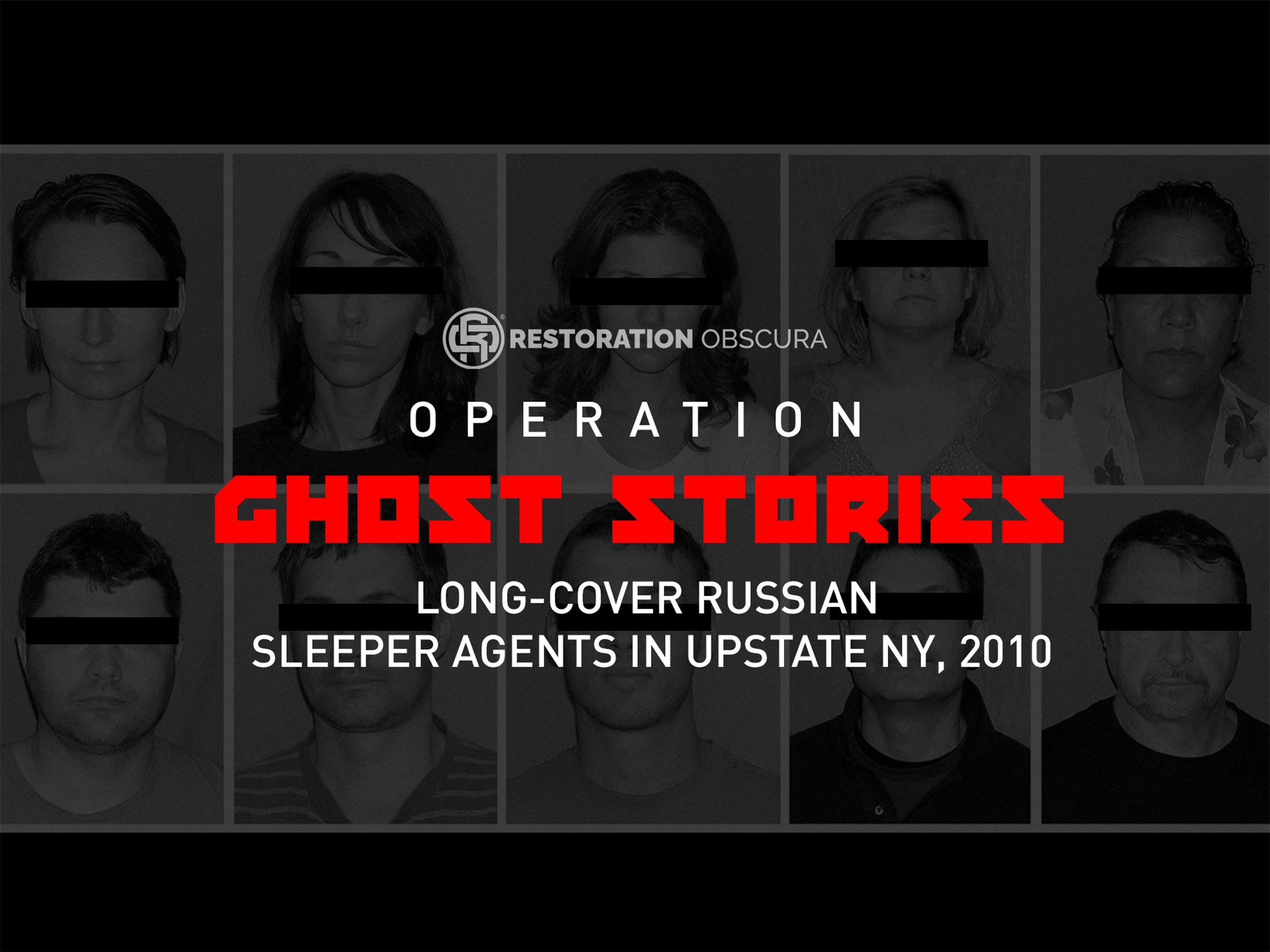
Operation Ghost Stories
Long-cover Russian Sleeper Agents in Upstate NY, 2010

This is a longform Restoration Obscura feature.
If you are receiving this article in your inbox, your email client may clip or truncate the content due to its length. You can always read the complete version directly on Restoration Obscura, where the full text is presented without interruption.
Restoration Obscura articles are written works intended to be read as text. Substack may automatically generate an AI-based audio narration of this article within the Substack app. Pronunciations of certain place names, personal names, and historical references in these auto-generated narrations may be inaccurate. The written version should be considered the authoritative source.
There is a rest stop on Route 17 near Wurtsboro, New York, tucked into the Catskills, unremarkable in every way. Truckers pull in. Families stretch their legs. Somebody walks a dog. On a spring day in 2004, a man drove into that rest stop, stepped out, and buried bundles of cash wrapped in silver duct tape in the ground.
He wasn’t hiding drug money. He was a Russian intelligence courier, moving operational funds for a network of deep-cover agents living inside the United States. The FBI was watching.
What unfolded was one of the most extraordinary counterintelligence cases in recent American history: a decade-long investigation the FBI called Operation Ghost Stories. It showed that, long after the Cold War ended, Russian intelligence still had patience, resources, and ambition on American soil.
The spies next door
Operation Ghost Stories began quietly. Over the late 1990s and 2000s, the FBI’s counterintelligence investigators noticed patterns: odd financial activity, suspicious communications, and people whose lives did not quite add up. What emerged was a network of Russian “illegals,” the term Moscow uses for deep-cover spies who operate without any diplomatic protection.
Unlike intelligence officers working under diplomatic cover at embassies, who enjoy legal immunity if caught, illegals assume completely false identities and live as ordinary citizens. If exposed, Russia cannot claim them. They have no diplomatic status, no official cover story, no protection. Just a fabricated identity and years of training to make it believable.
These were not movie-style spies in trench coats. They were neighbors. They had names like Richard and Cynthia Murphy. They went to PTA meetings. They had mortgages. Some had children born on American soil who had no idea who their parents really were.
Their mission was long-game infiltration. They were building cover identities so airtight that they could eventually work their way into proximity with policymakers, scientists, defense contractors, and intelligence officials. They weren’t stealing documents yet. They were becoming Americans first. The documents would come later.
The FBI watched them for years. And then came the Catskills.
The Catskills dead drop
A dead drop is one of the oldest tools in the espionage playbook. Rather than two agents meeting face to face, which creates risk for both, one operative leaves something at a prearranged location, and another retrieves it later. No contact. No witnesses. Just a location both parties know, and an object hidden in plain sight.
In the movies, dead drops happen in ornate locations: hollowed-out park benches in Vienna, loose bricks in London alleyways. In real life, they happen at rest stops off Route 17 in the Catskills.
In 2004, the FBI tracked Christopher Metsos, a Canadian passport holder and SVR courier whose job was to move money between Moscow and the sleeper network inside the United States, to that rest stop near Wurtsboro. Agents had been watching him for some time. They watched him pull in, step out, dig a hole, bury the cash, and drive away.
The FBI dug it back up: bundles of bills wrapped in silver duct tape, funding the operational costs of an entire spy network embedded in American society. Then they put cameras in the area and waited. This is the part that doesn’t make it into the movies: they waited years. The patience required, on both sides, was extraordinary.
It was, in the most literal sense, exactly what you’ve seen in the movies. Except it was real, and it was happening in New York State, an hour and fifty minutes from Albany.

Keep reading with a 7-day free trial
Subscribe to Restoration Obscura to keep reading this post and get 7 days of free access to the full post archives.