

270 Degrees
Saratoga's Devil's Chair and Rensselaer County's Mysterious Stone Throne

This is a longform Restoration Obscura feature.
If you are receiving this article in your inbox, your email client may clip or truncate the content due to its length. You can always read the complete version directly on Restoration Obscura, where the full text is presented without interruption.
Restoration Obscura articles are written works intended to be read as text. Substack may automatically generate an AI-based audio narration of this article within the Substack app. Pronunciations of certain place names, personal names, and historical references in these auto-generated narrations may be inaccurate. The written version should be considered the authoritative source.
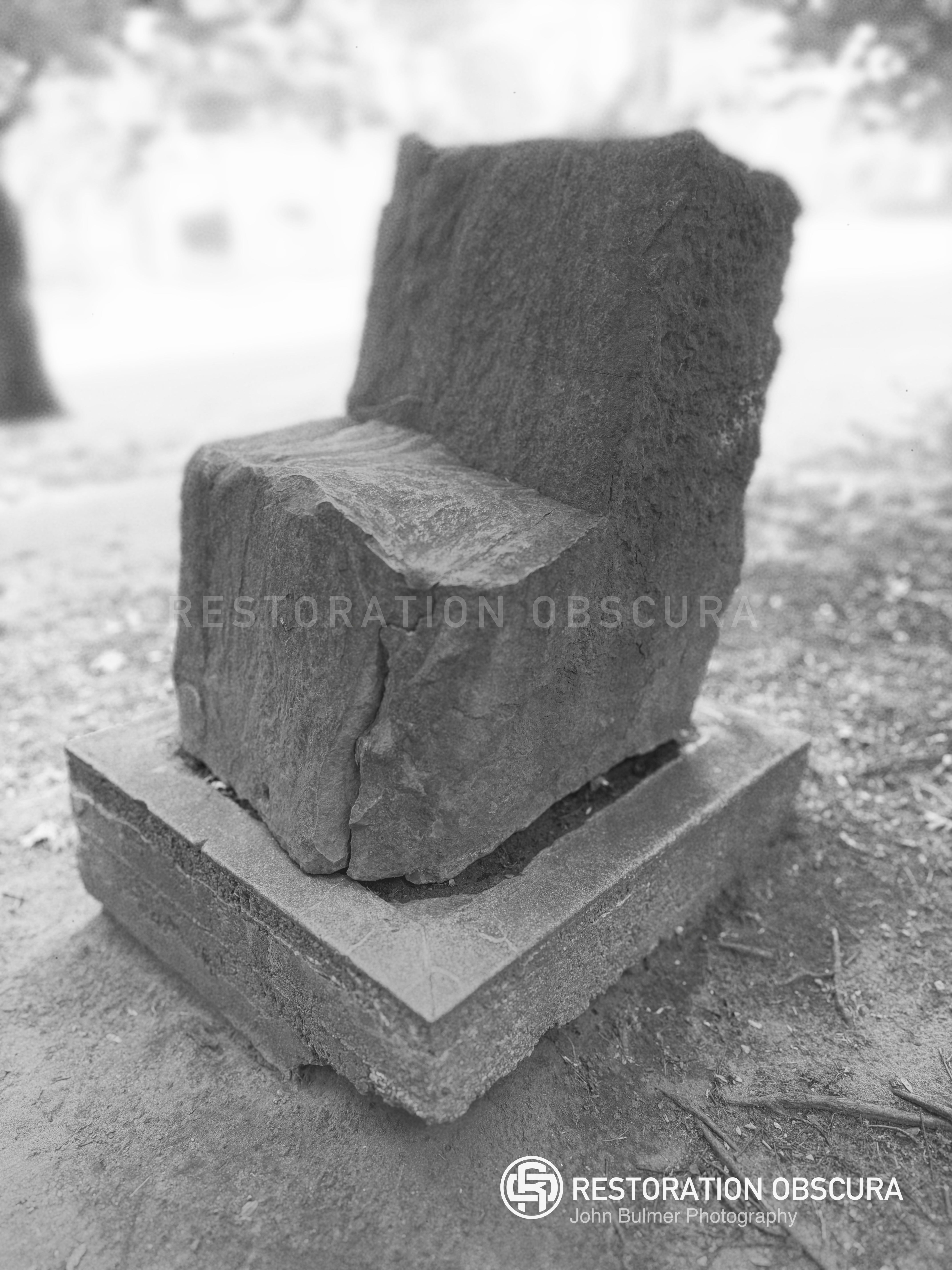
I do not know when the chair was cut, who set it on its base, or what they meant by it. No record I have found fixes its age or its purpose, and I am not going to invent one. What I can measure is the direction it faces, and that direction has company. People have aligned stone to the sunset for as long as there has been stone to move: the Neolithic builders who set the passage at Newgrange to catch the winter solstice, the ring at Stonehenge framing the same sun five thousand years ago, the medieval and colonial surveyors who squared churches and town greens to the compass. A block that holds 270 degrees, due west, sits inside that long habit whether its maker intended it or not. The measurement is the fact. Everything past the measurement is where I mark the line between what I can show and what I can only wonder.
The Devil’s Chair: Congress Park, Saratoga Springs, N.Y.
Stand behind the stone chair at the north end of the great meadow, near the Union Avenue entrance, and raise a compass. The needle settles between 269 and 270, a degree that any compass, GPS drift, or hand on the dial could account for. Call it due west, the direction we picture when we picture a sunset, even though the real sun only lines up there twice a year, at the equinoxes.
People have written about this stone for a century. I have written about this stone. The legend says workers quarried it as the cornerstone of an Episcopal church, gamblers took the park instead, and the abandoned block picked up the devil's name. Sit in it long enough, the story goes, and you lose your grip on the hour. The tellings do not even agree on the details. The Daily Gazette, cataloguing the park in 2015, calls it the abandoned cornerstone of an Episcopal church. Other tellings make the congregation Presbyterian. The accounts split again on why the work stopped, some saying the church would have sat too close to the gambling houses and the devil's garden, and split once more on when, some hanging the abandonment on Morrissey's clubhouse around 1870, others on Canfield's casino decades later, and at least one pushing the planned church back to the early 1800s, before either man had built a thing. The dates cannot all be right. That is the tell. A stone with a fixed history does not drift by half a century from one telling to the next. A century of stories, and I could not find anyone who had asked the simplest question: what direction does it face.
Keep reading with a 7-day free trial
Subscribe to Restoration Obscura to keep reading this post and get 7 days of free access to the full post archives.